46 Colors, One Bold Vision: Duncan Aviation Unveils Its Most Intricate Paint Scheme Yet
Duncan Aviation announces the completion of its most complex paint design to date—the first aircraft completed in Lincoln’s new paint hangar and a vivid example of what has happened over 70 years when customers trust the team to turn inspiration into reality. The aircraft, N1RD, is a milestone in creativity and craftsmanship.
Before it had a name, before anyone counted the colors, before eyes, flies, flowers, and hand-laid details covered nearly every inch of the aircraft, N1RD was a white Citation CJ3+ with factory stripes.
But Robert and Karen Duncan saw something else. They saw a blank canvas. They saw a chance to celebrate the kind of creativity Duncan Aviation is known for: bold, meticulous, a little unexpected, and executed with the kind of craftsmanship that turns an idea into something unforgettable. They saw an opportunity to challenge the team, open the doors of Duncan Aviation’s new Lincoln paint hangar with a statement, and create an aircraft that could not be mistaken for anyone else’s, demonstrating how Duncan Aviation helps aircraft owners transform personal inspiration into distinctive designs that reflect their identity while showcasing world-class craftsmanship.
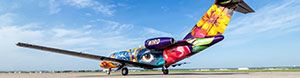
The aircraft is now a 46-color, full-scale piece of flying art—the most intricate paint design Duncan Aviation has ever completed, the first aircraft painted in the company’s new Lincoln paint hangar, and, for Robert and Karen, a vivid expression of adventure, trust, pride and fun.
Robert’s first reaction was one word: “Wow.” Karen’s was a question that could have served as the creative brief for the entire project: “How outrageous can we get?”
Robert embraced the word. “Outrageous is the word I think of every time I see the aircraft," he says. "We’ve watched a few steps during the paint process. It’s totally outrageous. It speaks to the creativity and the outstanding job that Duncan Aviation does day in and day out.”
For the Duncans, outrageous is not a gimmick. It is part of a much longer story. The two have spent decades collecting art, meeting artists, traveling the world, and turning airplanes into conversation pieces. In 1965, on their honeymoon to Acapulco, friends painted “just married” on the side of the small Beechcraft Travel Air Robert was flying. Everywhere they stopped, people gathered, laughed, took pictures, and asked about the airplane.
Maybe, Robert says, that was the start of all this.
More than 60 years later, that same spirit is still flying, only now it encases a Citation CJ3+, covering it in color, movement, and eyes that seem to look back at you, flies that feel like an inside joke between the aircraft and everyone who sees it.
Karen’s explanation for the flies is simple: “Because we’re flying.”
That is the charm of N1RD. It does not ask to be explained before it makes you smile. It is bold because Robert and Karen asked the team to be bold. It is complex because the team had the skill to make it possible. And it is powerful because, behind every color and every detail, there is a clear message about what Duncan Aviation can do when imagination and craftsmanship meet.
“This whole process actually started two years ago,” says lead designer, Hannah Mann. “We were all really excited to come up with something truly unique and custom and different from their previous planes that we’ve done in the past.”
“Oh, we just couldn’t wait to make it distinctive, to make it a Duncan Aviation product, a Duncan Aviation design, a Duncan Aviation paint job,” Robert says. “We’re known for that now. This is a fifth or sixth airplane that’s had a special paint job.”
The challenge began with inspiration artwork from Robert and Karen. Their direction was less a checklist than an invitation. Karen sums it up simply: “We want something crazy,” and Robert adds, “And they know us. They know our personalities. They know our sense of adventure, our sense of creativity. And we want that to reflect in what we fly, because that’s what Duncan Aviation is known for. Out on the edge, trying different things, experimenting, but doing it in a first-class way.”
From there, artists throughout Duncan Aviation’s Paint and Design teams were invited to submit ideas. Roughly 30 initial scheme submissions became 15 updated concepts. Completions Sales representative, Angie Coleman, says the selection process reflected the Duncan’s appreciation for creativity and trust in Duncan Aviation’s team members.
“Robert and Karen really wanted to have our artists here at Duncan Aviation put their ideas in,” Coleman says. “They gave us a piece of artwork, it went to the teams to put ideas out there, and then it was narrowed down and revised from there.”
Karen says she could have fallen in love with multiple schemes, but the team kept listening to the Duncan’s feedback.
“They’d bring us a number of different designs, and we’d say, ‘We like this about this one’,” Robert says.
Karen recalls the detail that kept coming forward. “Oh, we like the flies.”
Upon seeing the final concept, the decision was clear. “When we saw this one at the last meeting, everybody in the room said, 'Yes, this is the one,'” says Karen.
Robert’s direction was simple: “Go for it.”
The selected concept came from Paint master specialist, Troy Reinke, who wanted to create something unlike anything Duncan Aviation had painted before. “I was trying to come up with something that was unique, something we’d never done, something that was eye-catching, and also something that Robert and Karen would appreciate,” Reinke says. His inspiration leaned into Mexican art and culture, a personal connection to the Duncans and their longtime ties to Puerto Vallarta.
Among the surviving details were the flies. Small compared to the full sweep of the paint scheme, they became part of the aircraft’s personality on the tail, nose, and nacelles.
But the flies sit alongside another standout element: the eyes. Karen immediately saw their power in the design. Robert agreed they make the aircraft impossible to ignore. “The eyes are really distinctive. They jump right out at you.”
Even during layout, those details carried weight. Karen remembers seeing the aircraft covered in numbered sections and asking, “Well, where are the eyeballs?” The answer was number 29. “The plane was covered in numbers,” she says. “29 was the eyeballs.”
Reinke’s original artwork contained artistic details that looked striking on paper but had to be translated into something the Paint team could actually apply to an aircraft. That is where Mann’s design work became critical. “I took Troy’s drawing and split that out into individual shapes and pieces,” Mann says. “His original scheme had fades and highlights and shadows, and when we broke those out into individual shapes, we had to add those design elements back in. That’s where the 46 colors came from.”
Paint team leader, Brandon Boyer, says the Paint and Design teams talked through the scheme's conversion. “Once we had that, there was no fear,” Boyer said. “It was just a time concern.”
Reinke says the design required significant layout work before paint could even begin. The team had to break the design into sections, cut stencils, and prepare the aircraft so the scheme could be applied accurately at full scale. “With this type of scheme and this type of paint job, I absolutely can’t do this by myself,” he says. “It’s going to take a whole team of guys down there to accomplish this type of paint work.” Reinke estimates that at least 25 team members touched the aircraft before completion, including layout, paint, project coordination, sales, design, and leadership support.
Coleman says quoting and scheduling a paint job of this complexity required close coordination with the team. “With the number of colors that we have on there, we knew that every single color was going to have to be masked and unmasked,” she says. “So, we sat down with the team, went over how many labor hours this was really going to take, and where we could fit it in the schedule.”
That time concern was real, Boyer says, because N1RD’s complexity did not stop the rest of the Paint team’s work. “Just because we had this airplane to paint, we didn’t put everything else aside,” he says. “We still had our core aircraft to paint and give the same amount of attention to.”
That planning continued in a new space built for the future. Robert wanted the Citation CJ3+ to be the first aircraft painted in Duncan Aviation’s new Lincoln paint hangar, and the team made that happen.
“I’m really proud of the way that hangar turned out, and it’s special to have this as our first paint job,” Robert says.
Reinke says the new space helped support the work. “It’s bigger, it’s more open, it’s bright in there,” he says. “It’s definitely helping.”
Boyer says the new hangar also made the work easier in a very practical way. The facility was new, clean, and fully climate-controlled, which mattered during a complex project happening in 100-degree weather. “As hard as it was, it was great to have air conditioning,” he says. “It was super easy to control temperatures.”
For Robert, the hangar tells the same story as the aircraft: growth, capability, and confidence in the people doing the work. “It means that we’re growing and expanding and that we can paint bigger airplanes,” he says. “The hangar is terrific.”
In the clean, bright new space, the CJ3+ looked almost small, but the complexity of the scheme set the tone. “We’re the premier painter of aircraft in the world as far as I’m concerned,” says Robert. “We do the best quality jobs, and we’ve got the best teams.”
Boyer specifically credits Reinke with keeping the project moving, helping to manage progress on N1RD while the team also supported two or three other aircraft at the same time. “Trevor ran the day-to-day and did a phenomenal job,” Boyer says. “The team really stepped up and kept everything rolling.”
Reinke says the team handled the demanding, behind-the-scenes work required to bring the finish together. “I’m very proud of our team,” he says. “A project like this takes a tremendous amount of time, attention to detail, and teamwork. Much of the work that goes into creating the final product isn’t visible to those outside the project, but it’s those behind-the-scenes efforts that make a finish like this possible.”
Project manager, Tony Chipman, helped coordinate communication and remove roadblocks, but he is quick to point the credit back to the team. A typical artist may work alone, but this aircraft required many people working together across multiple shifts. “Your average artist is the sole mind and labor behind the art they create,” he says. “That isn’t the case here. At times, there were 10 different people working and painting this aircraft across multiple shifts. That kind of collaboration required patience, communication, and trust. Even when the work was challenging, the team stayed focused and continued to show up for one another.” He continues, “I have complete trust in our team members to do their jobs. Their passion comes out in everything they do.”
For Chipman, the aircraft is more than a painted machine. It is a piece of art unlike anything that could hang on a wall or canvas. “It is one thing to paint this on a wall in an alley somewhere or a piece of canvas,” he says. “But I have never seen a piece of canvas or a wall maintain flight at 400+ mph and 40,000 feet.”
That reality added many layers of complexity. Unlike traditional art, the project had to meet aviation requirements and withstand the conditions of flight. “Painting a piece of art comes with many added complexities that the typical artist doesn’t have to worry about,” Chipman continues. “For one, the FAA and manufacturers have standards for how and what you can paint with. This is a piece of art that has to stand up to an environment that no other art is subjected to.”
For Coleman, projects with the Duncan family are especially rewarding because of the creative freedom they give the teams. “Working with the Duncan family is the absolute best,” he says. “They let our designers design, our paint teams paint. They love art, and they’re so open-minded to anything somebody might bring forward. You’ll see that in this paint scheme.”
Boyer says there was pressure in painting an aircraft for Robert and Karen, but not because they were difficult customers. It was the opposite: the team knows how supportive and appreciative they are, which made everyone want to deliver something exceptional. “They are the ultimate customers to work for,” Boyer says. “They show up and tell us how great everything is. We make it tougher on ourselves knowing who they are and what they do for us.”
Reinke says Duncan family projects also carry pressure because of both the creativity involved and the visibility the aircraft will have across the company. “This is the fourth Duncan aircraft I’ve been involved with and the second one I’ve led,” he says. “There’s always extra pressure with a Duncan project for several reasons. Each aircraft becomes more creative and intricate than the last, which is exciting, but it also brings new challenges that require careful planning and execution. We also know these aircraft will remain in-house and be seen by people across the company, so there’s an added expectation to deliver our very best work.”
Although Duncan Aviation has completed many colorful and custom aircraft over the years, this one stands apart. The previous family aircraft, N1KD, used roughly 26 or 27 colors. This CJ3+ nearly doubles that count. “It’s the most we’ve ever done,” Coleman says.
For Reinke, the boldness of N1RD also made the aircraft especially rewarding to paint. “After painting Matterhorn White with red and blue stripes over and over, it’s refreshing to work on something this bold and unique,” he says. “Projects like this don’t come around often, and being able to step back at the end and see the finished aircraft gives you a real sense of pride and accomplishment.”
That pride is exactly what Robert and Karen hope the finished aircraft reflects. “The Duncan Aviation teams—the Design team, the Paint team—should be really, really proud of what they’ve done," Robert says. "That’s probably the most important thing.”
Karen says the attention should go exactly where it belongs: “The teams should get as much attention as the airplane.”
After two years of ideas, revisions, planning, layout, masking, painting, and teamwork, Reinke says the reaction the team hopes for is simple. “Jaw drop,” he says.
“I have a great big smile every time I see it,” Robert said. “It’ll just brighten your day when you see it. It’ll brighten everyone’s day.”
More than anything, he sees the CJ3+ as a statement about Duncan Aviation itself. “This is just another way to showcase what Duncan Aviation is, what we are capable of, what we love, how much fun the company is,” he says. “This talks about having fun, and we do have fun at Duncan Aviation. Yeah, it’s a wonderful expression of the company.”
For more on N1RD, including the full photo gallery and behind-the-scenes video, visit https://duncanaviation.aero/refurbishment/n1rd-outrageous-by-design-citation-cj3.